
- Home
- Age Level
- 0-6 Months (3)
- 10+ (4)
- 12+ (14)
- 12-16 Years (12)
- 14+ (4)
- 14, Kids (5)
- 16+ (20)
- 17 Years & Up (238)
- 3 Years And Up (2)
- 3-4 Years (4)
- 5-7 Years (10)
- 6-12 Months (2)
- 8 Years & Up (3)
- 8-11 Years (16)
- Adult (14)
- Adult Collector (8)
- Adult Collectors (2)
- End 19th (2)
- Not A Toy Collectors (2)
- Unknown (3)
- Other (5158)
- Artist
- Armand Marseille (25)
- Brinn Dolls (8)
- Dianna Effner (22)
- Donna Rubert (11)
- Elke Hutchens (17)
- Emma Clear (6)
- Heinrich Handwerck (10)
- Janis Berard (11)
- Jumeau (14)
- Kammer & Reinhardt (11)
- Kestner (20)
- Marie Osmond Dolls (17)
- Patricia Loveless (12)
- Rustie (27)
- Simon & Halbig (15)
- Thelma Resch (10)
- Unknown (41)
- Virginia Turner (8)
- Wendy Lawton (19)
- William Wallace Jr. (8)
- Other (5214)
- Doll Size
- Material
- Bisque (530)
- Bisque & Composition (8)
- Bisque Porcelain (12)
- Bisque, Cloth (10)
- Bisque, Composition (59)
- Bisque, Porcelain (42)
- Ceramic (91)
- China / Porcelain (589)
- Cloth (24)
- Cloth, Porcelain (71)
- Composition (16)
- Fabric, Porcelain (12)
- Porcelain (1976)
- Porcelain & Cloth (10)
- Porcelain / Cloth (9)
- Porcelain And Cloth (10)
- Porcelain, Cloth (35)
- Porcelain, Fabric (14)
- Porcelaine (7)
- Vinyl (8)
- Other (1993)
- Set Includes
- Accessories (16)
- Accessories, Doll (33)
- Clothing (5)
- Coat (4)
- Display Stand (6)
- Display Stand, Doll (6)
- Doll (1660)
- Doll & Outfit (6)
- Doll, Accessories (12)
- Doll, Clothes (5)
- Doll, Clothing (6)
- Doll, Hat (8)
- Doll, Outfit (32)
- Doll, Stand (6)
- Dolls (5)
- Figures (7)
- Hat (8)
- Outfit (15)
- Shoes (6)
- Wig (7)
- Other (3673)
- Unit Of Sale
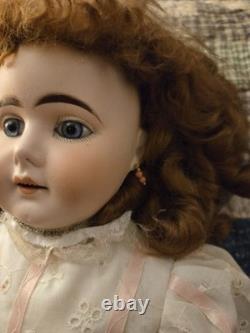
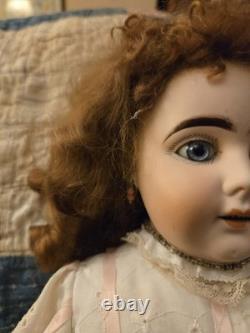
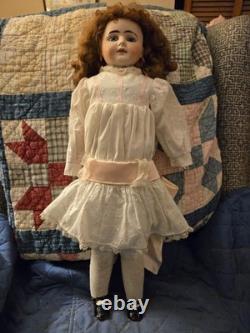
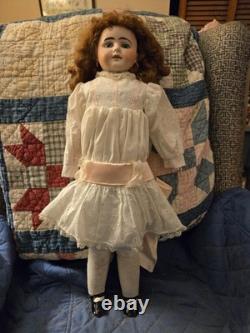
RARE! 23-Inch Liebe & Hoffman Bisque Shoulder Head Doll In White Cotton Eyelet
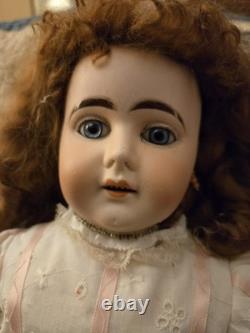
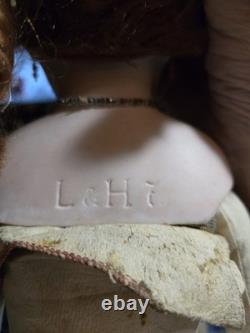


Liebe and Hoffman were porcelain manufacturers in Germany in the late 1700s throughout the 1800s. With the popularity of bisque dolls, they decided to get into the business of developing these bisque heads for the general public in the early 1880s. However, things were not as lucrative in the doll business as they desired, and they stopped manufacturing the bisque dolls in 1888, with only seven years of making the dolls. I have come across seven dolls in my career as a refurbisher.
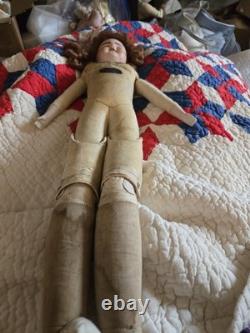
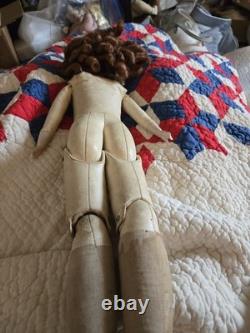
Most consisted of very small examples. However, lately, I have had the luck of getting access to two much large incarnations, one of which is here. She is not perfect: she has a broken and mended shoulder plate that appears to have happened long before I got her.
I would not have even discovered this, had not her original body broken in two at the waist, necessitating me to access another leather body that didn't cover her flaws as well. Thislt imperfection is well-hidden beneatockin sth her clothing, and the rarity of the doll negates any real dings to the doll's antique worth from this. Our girl has beautiful paperweight, blueon eyes, which are quite large and expressive.
Her mohair wig is light brown, and fashioned in sweet sausage curls in the sides and back, with tiny curls to frame her face. Her ensemble begins with a white eyelet vintage dress with pink ribbon embellishments at bodice level and on the lace belt loops on the drop waist. A huge satin pink sash is snaked through these loops and ends in a large bow at the dress back. Beneath the dress is a gossamer slip that takes the shape of culottes as it sewn up the middle.
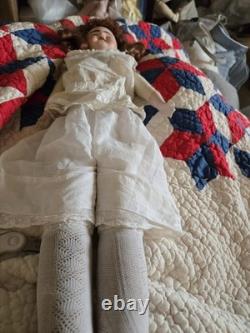
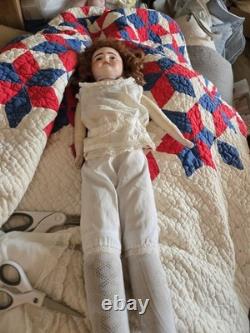
It is followed up by white pantalettes, white stockings, and black pattern leather shoes strapped on her feet. Tiny pink two-beaded earrings complete this charming doll.